
St Mary’s Gate School - A Quintessential British Girls' School
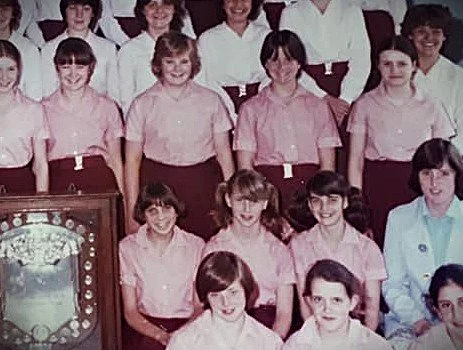
We had just won a choir competition in Southampton.
My father was giving clarinet lessons at a private girls’ school, and the head teacher said I would be welcome there. I was awarded a grant, and this became my new school. It was called St Mary’s Gate and was situated in the seaside town of Southbourne, a suburb of Bournemouth. It felt as though it had materialised from another century, and I had stepped back in time — boaters in the summer, cloche hats in the winter, white gloves, a maroon pleated skirt, jumper and blazer, fawn knee-length socks, and either a camel hair coat or a long grey mac. We certainly stood out in a crowd in that wonderful uniform. The school taught traditional subjects, and there were some remarkable teachers, including the extraordinary pioneering head, Kathleen Cook (Mrs Cook), who set up the school to inspire ‘young ladies to success, singlehandedly in the 1950’s, and it attracted pupils from around the world who wanted a traditional British education. Her life should be celebrated now, as this was a big thing in the 1950’s, where most women were expected to be housewives.
Mrs Cook was probably in her late 60s when I became a pupil at the school, and she wore huge pink floral hats and matching pink floral dresses, and her legs poked out on either side of her skirt like table legs, resembling Margaret Rutherford playing the part of a headmistress. She played the freestanding organ every morning for assemblies, which were held in a 1950’s prefab hall. She was an incredible English teacher, and the things that she taught I still use to this day. The deputy head, French Teacher, was very traditional looking, dedicated to teaching, with black, greying, combed back hair dripping with Brylcreem, and wore traditional tweed in all weathers – he lived in a small lodge house of a college at the end of the village where I grew up. The Latin teacher had a round, moon- face that grew redder as the lessons went on and as he dished out punishments, and the geography teacher, looking like a geography teacher wearing brown cord trousers and a tank top, had extraordinary aim with a board rubber or a piece of chalk — it never quite hit you, but it would whistle past your ear if your attention wandered. The maths teacher was kind, and outside school, she was a local farmer. She would knit in class between writing long equations on the blackboard. The desks were old-fashioned and wooden, complete with flip-up lids and ink wells, and at the front of each classroom was a blackboard – most classrooms had a shelf full of fraying green cotton-covered school Bibles, complete with graffiti, and there was one world map on the dirty brown walls.
St Mary’s Gate was a boarding school, and I boarded from time to time when my parents were on tour. By then, they had formed The Palm Court Theatre Orchestra and Company in 1978, and it was now international. The school offered activities seven days a week, there was a school matron and various dorms in the main school and in a boarding house up the road. We would be up before dawn and homework before breakfast – long wooden tables filled the dining hall, and bowls of lukewarm concrete porridge sat on each table, white bread and various jars of spread. Boarders would mix sandwich spread with chocolate spread and stack the bread up in towers – the porridge was inedible. Mrs Cook sat at the head of the central table, and the prefects at the end of all the other tables – everything had to pass around the table and not across. When standing for grace, the benches would cram together so that none of us could stand upright. The Spanish chief in the kitchen smoked heavily whilst stirring large pots of whatever was on offer that day, and the cups of tea would give me the biggest migraine and stomach cramps.
I sang in the school church choir for school celebrations, and I took elocution lessons, which led to festivals in Southampton and Bournemouth, and LAMDA exams in prose and poetry. I played roles in school plays that I would never have been cast in professionally in my younger career, although I think I might have grown into them now, such as Madame Arcati in Noel Coward’s Blithe Spirit. We had visiting actors come to the school, invited by Mrs Cook, including Felicity Kendal’s parents, Geoffrey Kendal and Laura Liddell, who are famed for touring Shakespeare in India. The 1965 film ‘Shakespeare Wallah’ was based on them. I remember they were very old-fashioned, theatrically; the set included a large wicker skip (similar to a laundry basket), covered with red velvet and theatrical dust. An ornate screen sat at the back. They proclaimed Shakespeare, rather than our style of realistic acting these days. However, it was inspiring, and I love all things theatrical, especially Shakespeare. We were taken to see a traverse-style RSC production of The Crucible – where we were seated high up on either side of the action – you could see what was happening onstage and off, and I was hooked. This is what I wanted to do forever.
Mrs Cook was very keen that we learnt Shakespeare, and we would read around the class. This was part of Mrs Cook's traditional, structured approach and philosophy in teaching. Structure and order are something my brain doesn’t compute well as a neurodivergent. I would put my jumper on my legs and my trousers on my head, given half the chance. The structure and rhythm of Shakespeare gave me a way to write and understand grammar, language, and be creative – commas are breaths, and paragraphs are thought changes, etc. The rhythm and balance of text is like music. The musicality within writing connects and develops the brain in the same way as learning an instrument or listening deeply to classical music. The art teacher was also a great believer in technique, making us draw things like deck chairs and violins — again and again. That same sense of structure and form runs through art as it does through music and writing – not just line and composition but also colour. Practice, repetition, and a structured approach were exactly what I needed, and still do. This approach doesn’t cure neurodivergences; it gives us a way to communicate and express ideas, and to ultimately be creative. Otherwise, everything quickly becomes a muddle with too much information and thoughts, causing crashes, meltdowns and shutdowns. At home, my mum gave me exercises in drawing repeated patterns or following patterns. She encouraged me to draw and paint to a high standard, helping to develop both fine and gross motor skills. She believed that although my spelling might be poor, if my handwriting was good, people would take me seriously. Later, during my MA, I came across the work of Feuerstein, who believed that through focused, repeated drawing and spatial awareness exercises, every person can reach a higher level of functioning and learning potential, regardless of age or cognitive difference. It made me realise that all those exercises, Shakespeare and art were doing exactly that.
At 14 years old, and before my O-levels, the council stopped the grant for me to go there, and I was left in limbo. The reason was that although I was above average in intelligence, they thought that within the economic times, I wouldn’t get any exams - to this day, I don’t know what that means. Fortunately, there was a 6th form college in the middle of the New Forest that offered equivalents to O-levels and CSEs, Called CEE’s, which would lead onto A levels. Going there was a turning point in my life.